Follow Us


Evaluation vs Valuation in Finance

Evaluation vs Valuation: The Critical Difference Every Investor Should Know
In the world of investing, two words often appear side by side : evaluation and valuation.
They sound similar, but mixing them up can cost investors serious money.
Picture this: You’re assessing two promising startups. One has an inspiring founder, a loyal customer base, and glowing media coverage.
The other has steady revenue, conservative projections, and modest growth. You’ve evaluated both.
But until you value them; attach a price tag – you don’t truly know which is the smarter bet.
The confusion between these two concepts is one of the most common traps among new investors and entrepreneurs alike.
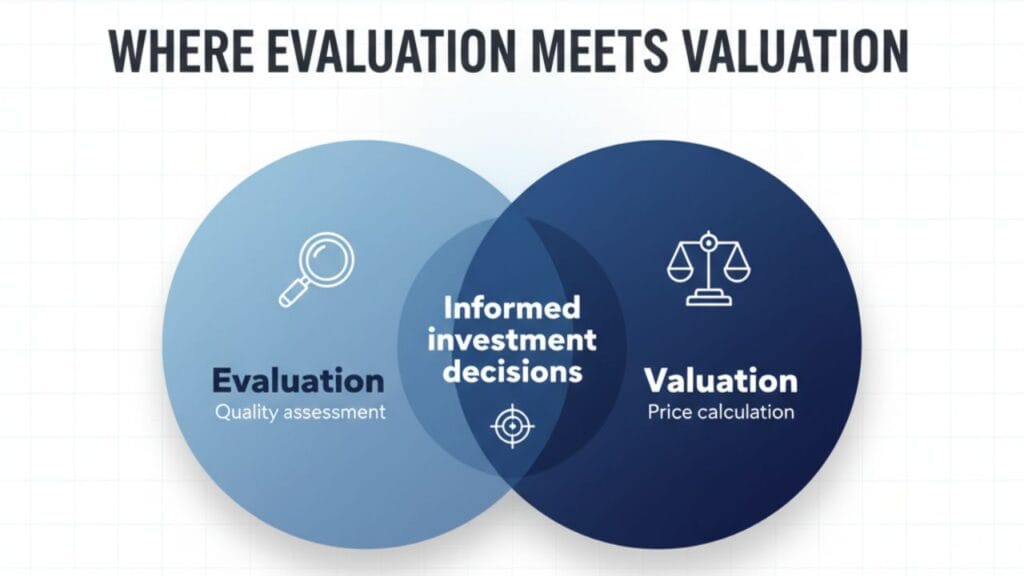
Evaluation helps you understand how good something is. Valuation tells you how much it’s worth. Both are essential, but they serve very different purposes.
Before diving deep, here’s a quick takeaway guide that clarifies everything at a glance.
Key Takeaways
- Evaluation assesses performance, potential & quality – the qualitative side.
- Valuation determines the financial worth – the quantitative side.
- Both are crucial: evaluation informs judgment; valuation determines pricing.
- Confusing them leads to poor decisions and mispriced investments.
- Use them together for smarter, evidence-based investing.
Core Difference between Evaluation and Valuation
At its core, the difference between evaluation and valuation comes down to purpose.
- Evaluation is about judgment; measuring quality, potential, or performance. It’s subjective and analytical, often involving both data and intuition.
- Valuation, on the other hand, is about measurement – calculating the monetary worth of a business, stock, or asset based on financial metrics.
Think of evaluation as reading a company’s story, while valuation is setting a price tag on that story.
Here’s a simple breakdown to help visualize the contrast:
| Aspect | Evaluation | Valuation |
|---|---|---|
| Purpose | Assess performance or quality | Determine financial worth |
| Focus | Qualitative factors (management, innovation, brand strength) | Quantitative factors (cash flow, earnings, growth rate) |
| Output | Opinion or rating | Monetary figure ($ or multiple) |
| Tools Used | SWOT analysis, due diligence, management interviews | DCF, Comparable Companies, Precedent Transactions |
| Used By | Analysts, investors, management teams | Bankers, investors, acquirers |
The key insight: Evaluation comes before valuation. You first evaluate a company’s quality & potential, only then can you confidently assign a financial value to it.
Related Posts:
81 Basic Stock Market Terms Every Beginner Must Know
What “Evaluation” Means in Finance
When analysts talk about “evaluating a company,” they’re not crunching numbers yet.
They’re studying its business model, market position, and management quality. Evaluation focuses on intangibles that shape long-term success.
For example, when Warren Buffett evaluates a company, he looks at leadership honesty, business simplicity, and competitive moat.
These aren’t directly measurable, but they determine whether a valuation will hold up in the long run.
Some key aspects investors evaluate include:
- Management capability – Are the leaders competent & ethical?
- Competitive position – Does the company have defensible advantages?
- Scalability – Can it grow without losing efficiency?
- Market sentiment – How is it perceived by customers & investors?
Financial evaluation doesn’t end at company performance. It can also mean assessing investment opportunities, portfolios, or even risk frameworks.
For instance, a fund manager may evaluate a sector’s resilience before allocating capital, long before doing any formal valuation.
Common evaluation tools include SWOT analysis, ESG scoring, and qualitative risk assessments. They give investors a holistic view, helping them decide whether it’s worth valuing at all.
What “Valuation” Means in Finance
If evaluation is about understanding a company’s quality, valuation is about calculating its price.
Valuation is the process of determining how much an asset, company, or investment is worth in monetary terms. It’s quantitative, data-driven, and grounded in financial models.
There are three main valuation approaches investors commonly use:
- Discounted Cash Flow (DCF): Estimates value based on expected future cash flows, discounted back to present value.
- Comparable Companies (Comps): Compares a company’s metrics (like P/E ratio) with similar firms in the market.
- Precedent Transactions: Looks at the price paid for similar companies in past mergers or acquisitions.
Each method produces a numerical estimate – but remember, a valuation is only as good as the assumptions behind it.
Let’s take an example:
Suppose you’re valuing Tesla. You’d forecast its cash flows, estimate growth, apply discount rates, and adjust for market risk.
But if your assumptions about demand or competition are off, your valuation might be wildly inaccurate.
That’s why valuation without evaluation can be dangerous. Numbers can mislead if not backed by qualitative understanding.
Always question the inputs before trusting the output. A precise model with flawed assumptions is worse than no model at all.
How Evaluation & Valuation Work Together
The best investors don’t choose between evaluation and valuation – they combine them.
Think of it like this:
- Evaluation answers: “Is this a good business?”
- Valuation answers: “Is this a good price?”
When both answers are yes, you’ve found an investment worth making.
Example:
Imagine you’re analyzing a new fintech startup.
- You evaluate its founders, market demand, technology, and competition.
- You then value it using comparable company multiples to see if the market price is justified.
If the company looks strong but the valuation is too high, you might wait for a correction. If it’s undervalued despite great fundamentals, that’s a buying opportunity.
This is why professionals often say:
“Evaluation tells you whether to care. Valuation tells you how much to pay.”
When investors integrate both sides : qualitative judgment + quantitative accuracy; they avoid emotional biases and make decisions that are both rational and profitable.
Common Mistakes & Misconceptions
Despite their importance, evaluation and valuation are often misused even by experienced investors. Let’s clear up the most frequent errors that lead to costly decisions.
1. Mistaking Opinions for Valuation
Many beginners confuse their evaluation of a company (“It’s a great brand!”) with a valuation. But liking a business doesn’t mean it’s priced fairly. A strong product or great management doesn’t guarantee the stock isn’t overvalued.
2. Overreliance on Models
A spreadsheet full of projections doesn’t make a valuation accurate. Overreliance on complex DCF models without sound evaluation can give a false sense of precision. Remember: even the cleanest model collapses under poor assumptions.
3. Ignoring Qualitative Factors
Some investors swing the other way, focusing purely on numbers while ignoring business health or leadership quality. Without evaluation, numbers lack narrative. A low P/E ratio might look attractive, but if the company’s leadership is weak, that “cheap” valuation may reflect hidden risks.
4. Believing Valuation = Truth
A valuation is an estimate, not a fact. It changes with interest rates, market mood, and new data. Smart investors treat it as a compass, not a destination.
In short, evaluation makes your valuation meaningful – without it, numbers are just decoration.
Practical Application for Investors
To make this distinction useful in real life, here’s a simple 3-step process every investor can apply:
- Evaluate First
- Study the company’s fundamentals, leadership, market position, and future potential.
- Ask: Would I trust this business to grow long-term?
- Then Value It
- Run valuation models like DCF or comparables to estimate its fair worth.
- Ask: What is this business realistically worth right now?
- Compare Price vs. Value
- If the market price < your valuation, it might be undervalued.
- If the price > your valuation, wait or avoid.
- Keep re-evaluating over time — markets & fundamentals change.
FAQ
Is evaluation the same as valuation?
No. Evaluation judges quality & potential, while valuation estimates financial worth. They complement each other but are not interchangeable.
Can a company have a high evaluation but low valuation?
Absolutely. A company might have excellent potential but be undervalued by the market; often an opportunity for value investors.
Which one should come first – evaluation or valuation?
Always start with evaluation. Only after understanding the business should you attempt to price it.
Conclusion
Evaluation and valuation are two sides of the same investment coin. One helps you understand a company; the other helps you price it.
Together, they transform gut feelings into disciplined decision-making.
Final thought:
Evaluation tells you the story; valuation puts a price on it.
Disclaimer:
This content is for informational purposes only and should not be considered financial advice.
Read full Disclaimer.